

Recessed Can Lights vs Pendants: Which Lights the Prep Surface Better?
Choosing between recessed can lights vs pendants for your kitchen prep surface is a fundamental decision that dictates both visual appeal and functional safety. While recessed options offer a clean, unobtrusive aesthetic that keeps sightlines open, pendants provide focused, task-oriented illumination directly where you chop, mix, and measure. Determining which system performs better depends entirely on your specific kitchen layout, the height of your ceilings, and your personal design preferences.
To achieve the best results, you must balance the ambient reach of recessed fixtures with the directional intensity of hanging lights. Understanding these trade-offs ensures your workspace remains safe and well-lit for every culinary task.
When evaluating whether recessed can lights vs pendants better illuminate a prep surface, the verdict is that pendants are superior for direct task lighting. Recessed fixtures excel at providing high-quality general lighting across a room, but they often cast shadows when you stand between the ceiling light and the countertop. Because pendants hang lower, they place the light source closer to the food preparation area.
This placement significantly reduces the likelihood of your body blocking the light while you work. For the most effective setup, most professional kitchen designers recommend a combination of both types to ensure consistent, shadow-free coverage.
Evaluating the Task Efficiency of Pendant Lighting

Pendants are arguably the most effective tool for illuminating a kitchen island or a dedicated prep surface. By hanging lower from the ceiling, they focus a concentrated beam of light directly onto the workspace.
This proximity minimizes the distance the light travels, which increases the intensity of the illumination on your cutting board or mixing bowl. You gain a level of precision that recessed lights struggle to provide, especially when working with knives or detailed recipes.
Because pendants serve as a focal point, they also offer a design advantage that recessed lights cannot match. You can select styles that complement your cabinetry, hardware, and overall kitchen theme.
However, their primary strength remains functional; they act as a “task-specific” light source. By installing them at the correct height—typically 30 to 36 inches above the countertop—you ensure the light is neither too diffused nor too harsh.
The Role of Recessed Lighting in General Coverage

Recessed lighting, often referred to as can lights, functions best as the backbone of your kitchen’s ambient lighting scheme. These fixtures are installed flush with the ceiling, maintaining a streamlined and uncluttered look.
They are perfect for low ceilings where hanging fixtures might feel overwhelming or physically obstructive. Even with their clean appearance, they are not always the optimal choice for direct prep work.
If you rely solely on recessed lights for your prep area, you must be strategic about their placement. Standard layouts often place these lights too far back, creating a scenario where your back is turned to the light source.
To mitigate this, place the recessed trim directly above the front edge of the countertop. This adjustment helps push the light onto the workspace rather than behind you.
Comparing Installation Requirements and Complexity

Installation processes differ significantly between these two lighting styles, which can influence your final decision. Recessed cans require specific housing depth within your ceiling joists, which can be a challenge in older homes or multi-story structures.
If you are retrofitting an existing kitchen, you might opt for modern LED recessed lighting, which often features “canless” designs. These slim, wafer-style fixtures fit into tight spaces where traditional deep housings cannot go.
Pendants are generally easier to install if you already have a junction box in place. If you are adding them to a location that currently has no wiring, you will need to run new electrical lines through your ceiling.
This is often more invasive than adding low-profile recessed lights. Consider the structural integrity of your ceiling and the existing electrical layout before committing to a specific fixture type.
Impact of Ceiling Height on Fixture Selection

Ceiling height is perhaps the most critical variable when choosing between recessed can lights vs pendants. In kitchens with ceilings lower than eight feet, pendants can quickly make the space feel cramped and visually busy.
Recessed lights are the natural choice for these environments because they preserve vertical volume. They prevent the “visual noise” that occurs when multiple hanging fixtures occupy a small room.
For kitchens with high or vaulted ceilings, however, pendants become a necessary design element. Without them, the ceiling may feel disconnected from the workspace, and the light from recessed fixtures may be too diffused by the time it reaches the counter.
Long-stemmed pendants can bridge the gap, bringing the light down to a human scale. This creates a cozy, intimate atmosphere that is much more inviting for cooking and socializing.
Analyzing Energy Efficiency and Bulb Technology
Modern lighting technology has leveled the playing field regarding energy consumption. Both recessed fixtures and pendants now predominantly utilize LED technology, which offers superior longevity and lower heat output compared to older incandescent options.
When you compare the energy efficiency of the two, the difference is negligible if you choose high-quality bulbs. The real difference lies in how you control the light.
Dimmers are essential for both systems to maximize energy efficiency and comfort. By installing a dimmer switch, you can crank up the brightness for intricate prep work and dim the lights for evening entertaining.
LEDs are highly compatible with most modern dimmers, allowing for a seamless transition between task and ambient modes. Always check the compatibility of your chosen fixture with your dimmer switch to avoid flickering or buzzing.
Strategic Placement for Shadow Reduction

Shadows are the primary enemy of a well-lit kitchen prep surface. If your light source is positioned behind you, your body will inevitably cast a shadow over your cutting board.
This is a common issue with recessed lighting that is improperly spaced. To solve this, you must analyze your kitchen layout from the perspective of the person standing at the counter.
Pendants are inherently better at avoiding this because they are usually hung in a series over an island. This creates a wash of light from multiple angles, which effectively cancels out most shadows.
If you choose recessed lights, try a “cross-lighting” technique. By placing two lights at different angles relative to your prep area, you ensure that even if one light is blocked, the other provides adequate illumination.
Comparing Costs and Maintenance
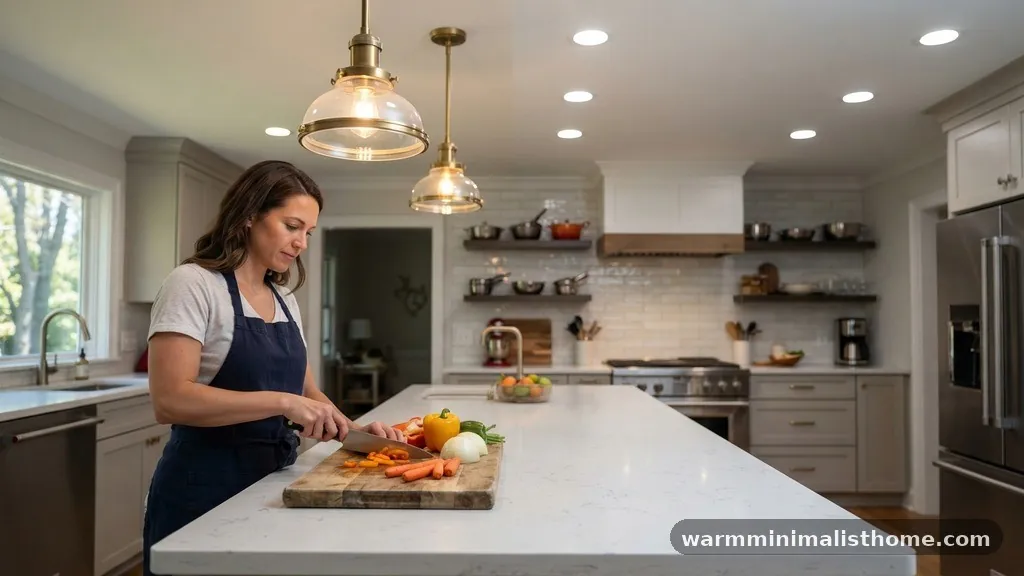
The financial commitment for these lighting types varies based on the quality of the fixtures and the complexity of the labor. Recessed lighting is often sold in bulk, making the individual unit cost quite low.
However, the labor cost for installing multiple cans can add up quickly. Pendants are often more expensive per piece, but you generally need fewer of them to achieve the desired effect.
Maintenance is another factor to consider over the long term. Recessed light bulbs are generally easier to clean, as they are protected within the fixture housing.
Pendants, especially glass or open-cage styles, act as dust magnets and require frequent wiping. If you prioritize low-maintenance living, the recessed route is the clear winner for your household.
| Feature | Recessed Lighting | Pendant Lighting |
|---|---|---|
| Primary Function | General/Ambient | Task/Accent |
| Ceiling Height Requirement | Any (best for low) | High (best for 8ft+) |
| Shadow Potential | High | Low |
| Visual Clutter | Minimal | Higher (Statement piece) |
| Installation Difficulty | Moderate (requires space) | Low (if junction exists) |
Design Trends and Aesthetic Impact

The look of your kitchen is heavily influenced by your choice of lighting fixtures. Recessed cans provide a minimalist, “invisible” aesthetic that allows your cabinetry or backsplash to take center stage.
This is a timeless look that fits well in contemporary, industrial, or even traditional kitchens. It is a safe choice if you plan on changing your decor frequently.
Pendants offer a chance to make a bold design statement. Whether you choose modern glass globes, rustic metal lanterns, or colorful ceramic shades, they draw the eye and define the space.
Many homeowners use pendants to introduce a splash of color or a specific texture into a neutral kitchen. If you want your kitchen to feel like a custom-designed space, pendants are a powerful design tool.
Common Mistakes to Avoid in Kitchen Lighting
Many homeowners make the mistake of installing only one type of light in their kitchen. Relying solely on recessed cans can leave the space feeling flat and sterile.
Conversely, using only pendants can leave dark corners throughout the rest of the kitchen. A well-designed kitchen requires a layered approach that integrates both types of light to achieve a balance of form and function.
Another common error is choosing the wrong bulb color temperature. For kitchen prep surfaces, you want a light that is crisp enough to see clearly but not so blue that it feels like a hospital.
Aim for a color temperature between 3000K and 3500K. This range provides a clean, neutral white light that accurately renders the colors of your food.
Frequently Asked Questions
Are recessed lights considered outdated?
No, recessed lights are not outdated; they have evolved into thinner, more efficient LED wafer models that are essential for modern kitchen design. They remain the gold standard for providing clean, unobtrusive general lighting that keeps a room feeling open and bright.
Can I mix recessed lights and pendants in the same kitchen?
Mixing both is actually the recommended approach for professional kitchen design. Recessed lights provide the essential ambient layer for the entire room, while pendants offer the focused task lighting needed for islands and prep surfaces.
How many pendants should I hang over an island?
The number of pendants depends on the length of your island. A good rule of thumb is to space them approximately 24 to 30 inches apart, starting from the center of the island. For most standard kitchen islands, two or three pendants are the perfect balance.
Do I need dimmers for my kitchen lights?
Dimmers are highly recommended for any kitchen lighting plan. They allow you to shift the mood from a bright, functional workspace for cooking to a soft, ambient setting for dining and entertaining. Most modern LED fixtures are fully compatible with standard LED-rated dimmers.
Are canless recessed lights better than traditional cans?
Canless or wafer lights are generally considered superior for renovations and retrofits. They are much easier to install, don’t require bulky housing, and offer excellent light output with very low energy consumption. They are the preferred choice for ceilings with limited clearance.
Conclusion
Deciding between recessed can lights vs pendants for your prep surface ultimately comes down to your priorities for light quality and visual style. If your primary goal is maximizing task accuracy and adding a decorative touch, pendants provide the focused illumination you need. If you prefer a minimalist, airy look that keeps your ceiling lines clean, recessed lights are the superior choice.
Most successful kitchens find success by layering both, using recessed lighting for general room illumination while reserving pendants for the island and prep zones. By considering your ceiling height and the specific layout of your workspace, you can select the right combination to make your kitchen both beautiful and highly functional. Start by identifying your highest-traffic prep areas, then choose the fixture that ensures you never have to work in your own shadow.