

Can You Use Semi-Flush Mounts Instead of Pendants Over Low Ceilings?
Deciding whether you can use semi-flush mounts instead of pendants over low ceilings is a common challenge for homeowners looking to improve their interior lighting. When vertical space is limited, traditional hanging fixtures often create a cramped feeling or physically obstruct movement in a room. You might wonder if swapping these for a more compact option will sacrifice the aesthetic appeal of your space.
Fortunately, the answer is a definitive yes; you can absolutely use these versatile fixtures to achieve a sophisticated look without compromising on comfort. This article provides the practical data and design strategies needed to make the right choice for your home.
The Verdict on Ceiling Height and Fixture Choice

You can certainly use semi-flush mounts instead of pendants over low ceilings to maintain an open and airy atmosphere. The primary reason for this switch is simple physics and clearance requirements. In residential design, a standard ceiling height is often 8 feet, which leaves little room for a decorative pendant to hang without being a hazard.
A pendant typically requires at least 30 to 36 inches of clearance above a dining table or kitchen island to remain functional and visually balanced. If your ceiling is less than 8 feet, hanging a long corded light will likely result in someone bumping their head or feeling visually crowded.
Semi-flush mounts act as the perfect middle ground between a completely flat flush mount and a hanging pendant. These fixtures feature a short stem or rod that drops the light source a few inches below the ceiling canopy, providing a touch of elegance that a standard flush mount lacks.
By keeping the light source closer to the ceiling, you maximize the vertical clearance in the room. This makes them an excellent choice for high-traffic areas, hallways, or rooms where you want to maintain a clear line of sight.
When evaluating whether to make this swap, consider the specific function of the area you are lighting. If you are working with a kitchen island, task lighting is non-negotiable. While a pendant offers focused light, a well-placed semi-flush mount can provide broad, ambient illumination that fills the entire workspace.
You can compensate for the lack of a downward-focused pendant by choosing a fixture with multiple bulbs or high-lumen output. This ensures you aren’t sacrificing utility for the sake of ceiling height.
Measuring Clearance for Your Lighting Plan

Understanding the math behind your ceiling height is the most critical step in successful lighting design. You should aim for a minimum of 7 feet of clearance between the bottom of any light fixture and the floor in high-traffic walking paths. If you are placing a fixture over a dining table, the rules shift slightly to accommodate the surface below.
In that specific scenario, the bottom of the fixture should sit roughly 30 to 34 inches above the tabletop. If your ceiling height is 8 feet and your table is 30 inches tall, that leaves only 66 inches of total space to work with.
Subtracting the table height from the ceiling height leaves you with 36 inches for the entire fixture. If you choose a pendant with a long chain or cord, you will quickly run out of room for the actual shade. A semi-flush mount, which typically drops anywhere from 4 to 12 inches from the ceiling, keeps the fixture well within the safe zone.
This allows for a more substantial light design that doesn’t feel like it’s looming over your guests while they eat. You can reference the U.S. Department of Energy lighting guidelines for further technical details on optimizing your home’s illumination.
Using a tape measure before you purchase any new hardware is essential. Do not rely on visual estimates when you are dealing with tight architectural constraints.
Mark the desired height on your wall with painter’s tape to see exactly how much volume the fixture will occupy. This small step prevents the frustration of ordering an expensive piece only to realize it creates a visual bottleneck in your living space.
Comparing Fixture Types for Low Ceilings
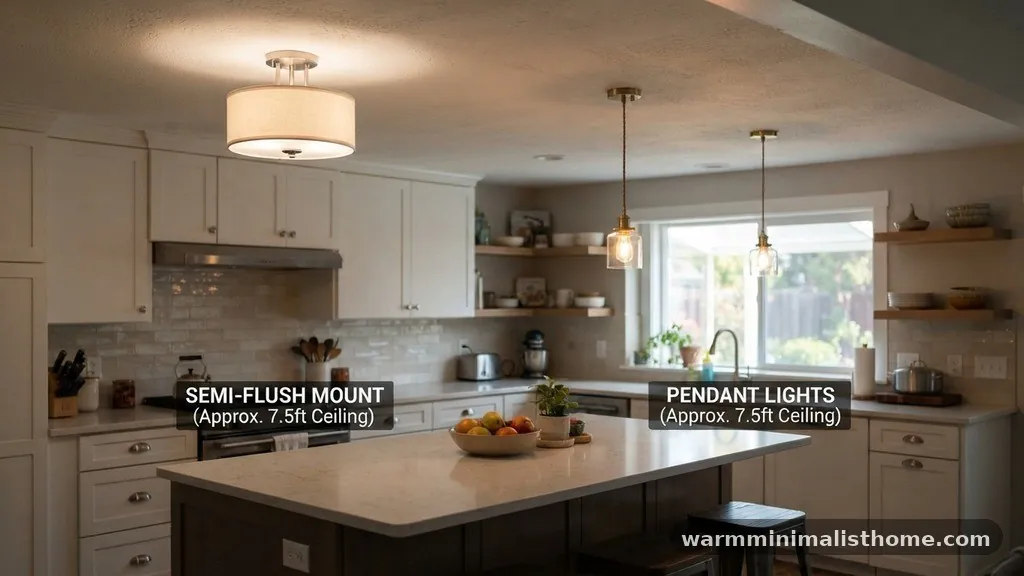
To understand the difference in impact, it helps to compare the three main mounting styles. Each type serves a specific purpose depending on the volume of your room and the height of the ceiling. A flush mount is attached directly to the ceiling surface, which is ideal for very low spaces like basements or closets.
A semi-flush mount offers a slight drop, adding a bit of decorative flair while staying compact. A pendant is suspended by a cord, chain, or rod, which is best suited for high ceilings or areas where you want a dramatic focal point.
| Fixture Type | Typical Drop Range | Best Use Case |
|---|---|---|
| Flush Mount | 0 to 3 inches | Walk-in closets, low-ceiling hallways |
| Semi-Flush Mount | 4 to 12 inches | Dining rooms, kitchens, bedrooms |
| Pendant | 12+ inches | High ceilings, kitchen islands, entryways |
The table above illustrates why the semi-flush mount is often the superior choice for standard 8-foot ceilings. While pendants provide a focused look, they often become a nuisance in rooms where people move around frequently.
Semi-flush mounts provide a balanced aesthetic that feels more intentional than a basic flush mount. They also offer more variety in terms of style, glass options, and metal finishes compared to their ultra-low-profile counterparts.
Design Strategies for a Cohesive Look

Choosing to use semi-flush mounts instead of pendants does not mean you have to settle for a boring design. Many modern manufacturers now produce semi-flush fixtures that mimic the shape and silhouette of classic pendants.
You can find designs that incorporate intricate glass shades, geometric cages, or even mini-chandeliers that fit snugly against the ceiling. The key is to select a fixture that complements the overall theme of your home, whether it is mid-century modern, industrial, or traditional.
If you are concerned about losing the “focal point” effect of a pendant, consider using a larger or more ornate semi-flush mount. Scaling is vital here. In a large room, a tiny, single-bulb fixture will look lost on the ceiling.
Instead, look for a wider, multi-light fixture that creates a sense of presence. This draws the eye upward and adds a layer of depth to the room that a smaller, simpler light simply cannot achieve.
You can also use multiple semi-flush mounts in a row to create a visual rhythm similar to a series of pendants. This works particularly well in long, narrow hallways or over a long kitchen island.
By placing two or three of these fixtures in a line, you maintain the symmetry and balance often associated with pendant lighting. This approach is highly effective in modern homes where clean, repetitive lines are a hallmark of the interior design.
Material Considerations for Small Spaces

The materials you choose for your light fixtures significantly influence how large or small a room feels. In a low-ceiling space, you want to avoid heavy, opaque materials that cast harsh shadows or make the ceiling feel lower.
Glass is an excellent choice because it allows light to pass through, creating an airy and translucent effect. Clear glass, seeded glass, or frosted glass shades can help distribute light evenly across the ceiling and walls, which makes the room appear more spacious.
Metal finishes also play a role in the perception of space. Reflective surfaces like polished nickel, chrome, or brass can bounce light around the room, adding a sense of brightness.
Conversely, matte black or dark bronze finishes can provide a sharp, modern contrast, but you must ensure the fixture itself isn’t too bulky. If you go with a darker finish, keep the design open and airy to prevent it from feeling like a heavy weight hanging over the room.
Consider the bulb type as well, as this affects the quality of light and the heat output. LED bulbs are highly recommended for semi-flush mounts that sit close to the ceiling.
Because they run cooler than incandescent bulbs, they are safer for fixtures that are tucked into a shade or glass housing. They also offer a range of color temperatures, allowing you to choose between a warm, inviting glow or a crisp, daylight-balanced light that makes small rooms feel more energized.
Common Mistakes to Avoid

One of the most frequent errors people make is choosing a fixture that is too small for the room. Just because you have a low ceiling doesn’t mean you should pick a miniature fixture that gets swallowed by the architecture.
A good rule of thumb is to calculate the diameter of the fixture by adding the room’s length and width in feet, then converting that number to inches. For example, a 10×12 foot room should ideally have a fixture that is roughly 22 inches in diameter.
Another mistake is failing to consider the light distribution pattern. Some semi-flush mounts are designed to cast light primarily downward, while others project it in all directions. If your room has dark corners, you want a fixture that allows light to hit the ceiling and upper walls.
This “uplighting” effect is a classic designer trick to make a ceiling feel higher than it actually is. Avoid fixtures that direct 100% of their output toward the floor, as this creates a “spotlight” effect that can make the rest of the room feel dim and cramped.
Finally, do not forget to address the switch situation. If you are moving from a single pendant to a semi-flush mount, you might want to install a dimmer switch.
Dimmers give you total control over the atmosphere and are particularly useful in multi-functional spaces like dining rooms or bedrooms. Being able to soften the light makes a significant difference in how a room feels, regardless of the fixture’s height or size.
Lighting as a Design Element

Lighting should be viewed as a layer of design rather than just a functional necessity. When you use semi-flush mounts instead of pendants, you are making a conscious choice to prioritize flow and openness.
This shift in perspective allows you to play with different textures and shapes that might have been too intrusive if they were hanging lower. For instance, a drum-style semi-flush mount with a fabric shade can add a soft, sophisticated texture to a bedroom or living area.
You can also use lighting to define different zones in an open-plan house. If your kitchen and living room share the same space, you might use pendants over the kitchen island where the ceiling is high enough, and transition to matching or complementary semi-flush mounts in the living area.
This creates a cohesive narrative throughout the home while respecting the physical limitations of different ceiling heights. It shows an attention to detail that elevates the entire design scheme.
Don’t be afraid to mix and match styles. While consistency is important, you don’t need every single fixture in your home to be identical. Using a consistent metal finish across your hardware—such as all brushed gold or all matte black—allows you to experiment with different fixture shapes.
This keeps your home looking curated rather than like a showroom catalog. It also provides the flexibility to update your lighting over time as your tastes change.
Maintenance and Installation Tips
Installing a semi-flush mount is generally a straightforward project for anyone with basic electrical knowledge, but safety must always come first. Always turn off the power at the circuit breaker before touching any wiring.
If you aren’t comfortable working with electricity, hire a licensed professional to ensure the fixture is properly anchored to the ceiling box. This is especially important for heavier fixtures that use glass or ceramic elements, as they require a secure mount to prevent any risk of falling.
Once installed, maintenance for these fixtures is relatively simple. Because they sit closer to the ceiling, they may collect dust more quickly than a pendant.
Plan to wipe down the shades or glass elements every few months to keep the light output clear and bright. If you have a fixture with intricate metalwork, a soft brush or compressed air can help dislodge dust from hard-to-reach crevices.
Keep spare bulbs of the correct wattage and base type on hand so you aren’t caught off guard when one burns out. If you have multiple fixtures in a room, it is often better to replace all the bulbs at once if one fails, especially if you are using LED bulbs that have a specific color temperature.
This ensures the light quality remains uniform throughout the space. Taking these small steps will keep your home looking polished and well-cared for.
Frequently Asked Questions
Are semi-flush mounts considered modern?
Yes, they are very popular in modern design. Contemporary manufacturers are creating sleek, minimalist semi-flush options that fit perfectly into updated homes. You can find everything from mid-century inspired Sputnik designs to clean, industrial drum shapes that look anything but dated.
Can I use a semi-flush mount over a kitchen island?
You certainly can, though you will need to account for the lack of concentrated downward light. To make this work, look for a fixture with multiple bulbs or a design that allows for brighter LED lamps. If the island is long, consider installing two or three smaller semi-flush mounts in a row to provide even coverage.
Do semi-flush mounts make a room look smaller?
Quite the opposite, they can make a room feel larger. By keeping the fixtures closer to the ceiling, you clear up the “visual noise” that comes with hanging pendants in a low-ceiling space. This creates a more open sightline and makes the room feel taller and less cluttered.
What is the minimum ceiling height for a pendant?
A general rule of thumb is that you should have at least 8 feet of ceiling height to comfortably hang a pendant without it feeling like an obstacle. If your ceiling is 7.5 feet or lower, a pendant will almost always feel too low. That is the ideal scenario to switch to a semi-flush mount or a recessed light.
How do I choose the right size fixture for my room?
A reliable method is to add the room’s length and width in feet and convert that number into inches for the diameter of the fixture. For example, a room that is 10 feet by 10 feet would work well with a 20-inch wide fixture. Always ensure you have at least 7 feet of clearance from the floor to the bottom of the fixture in walking areas.
Making the Right Choice for Your Space
Choosing to use semi-flush mounts instead of pendants over low ceilings is a smart, design-forward decision that prioritizes both form and function. By opting for these fixtures, you regain valuable vertical clearance while still having the opportunity to express your personal style through a wide range of shapes and finishes. Remember to measure your space carefully, account for the proper clearance, and choose materials that maximize light distribution.
Whether you are aiming for a minimalist, industrial, or traditional aesthetic, there is a perfect fixture out there that will fit your room without making it feel small. If you have any further questions about your specific room dimensions or lighting needs, don’t hesitate to reach out to a local lighting professional for a consultation.